
MK-4830
(anti-ILT4 antagonist)
Catalyzes reprogramming of tumor-associated macrophages, relieving myelosuppression and enhancing T cell function
Immunoglobulin-like transcript 4 (ILT4, also known as LILRB2) is an immunosuppressive receptor commonly expressed by many myeloid lineages, including monocytes, macrophages, granulocytes, and dendritic cells. In the tumor microenvironment, ILT4 is expressed by myeloid-derived suppressor cells (MDSCs), which suppress T-cell activation, proliferation, and effector responses. MK-4830 is a first-in-class ILT-4 antibody designed to abrogate PD-1 resistance by reprogramming myeloid cells into a proinflammatory state and enhancing the anti-tumor T cell response.
In a first-in-human study (NCT03564691) in advanced solid tumors, the combination of MK-4830 with pembrolizumab (PD-1) resulted in a 24% response rate, with multiple responses observed in patients progressing on prior PD-1 therapy and all responses maintained for at least 6 months. A Phase II study of MK-4830 in combination with pembrolizumab and chemotherapy with or without bevacizumab in neoadjuvant ovarian is ongoing.
Merck has an exclusive worldwide license to MK-4830.
Questions? Speak to Medical Expert
INCAGN2390
(anti-TIM-3 antagonist)
Targeting T Cell Exhaustion and Dysfunction
T-cell immunoglobulin mucin-3 (TIM-3) is an immune checkpoint receptor expressed on the surface of cytotoxic T cells, regulatory T cells (Tregs), monocytes and natural killer (NK) cells. Increasing expression of TIM-3 on cytotoxic T cells and NK cells are associated with immune cell exhaustion and infection. In addition, Tregs expressing TIM-3 show enhanced immunosuppressive function, and TIM-3 signaling can suppress the immune function of monocytes. INCAGN2390 is designed to potently block TIM-3 to reinvigorate T and NK cells and reduce immunosuppression by Tregs.
Incyte has an exclusive worldwide license to INCAGN2390, and is developing a unique triple combination of INCAGN2390 with INCAGN2385 (LAG-3) and PD-1 in melanoma and squamous cell carcinoma of the head and neck (SCCHN).
Questions? Speak to Medical Expert
INCAGN2385
(anti-LAG-3 antagonist)
Addressing T Cell Exhaustion and Suppression
Lymphocyte-activation gene 3 (LAG-3) is an immune checkpoint receptor expressed on the surface of both activated cytotoxic T cells and regulatory T cells (Tregs). The presence and activity of LAG-3 steadily increases with exposure to tumor antigen, leading to T cell exhaustion. Tregs expressing LAG-3 also gather at tumor sites and show potent suppression of cytotoxic T cells. INCAGN2385 is designed to potently block LAG-3, to enable T cells to regain their cytotoxic function and abrogate immunosuppression by Tregs.
Incyte has an exclusive worldwide license to INCAGN2385, and is developing a unique triple combination of INCAGN2385 with INCAGN2390 (TIM-3) and PD-1 in melanoma and squamous cell carcinoma of the head and neck (SCCHN).
Questions? Speak to Medical Expert
CR6086 + Balstilimab
Rottapharm Biotech is conducting a clinical trial combining balstilimab (PD-1 antagonist) with CR6086 (EP4 antagonist) in patients with pMMR-MSS colorectal cancer. CR6086 is expected to inhibit the immune suppressive role of prostaglandins in the tumor microenvironment, improving immunogenicity and responsiveness to immunotherapy. The Phase 1/2 study commenced in 2021.
Questions? Speak to Medical Expert
NLM001 + Zalifrelimab
Nelum is conducting a clinical trial combining zalifrelimab (CTLA-4 antagonist) with NLM-001 (hedgehog inhibitor) and chemotherapy in patients with advanced pancreatic cancer. NLM-001 in combination with chemotherapy is anticipated to condition the tumor microenvironment to improve T cell infiltration, activation, and responsiveness to immunotherapy. The Phase 1/2 study commenced in 2021.
Questions? Speak to Medical Expert
OBT076 + Balstilimab
Oxford BioTherapeutics is conducting a clinical trial combining balstilimab with OBT076 (CD205-targeting antibody-drug conjugate) in patients with solid tumors, including lung, gastric, and ovarian cancer. OBT076 is expected to deplete CD205+ cancer cells, and immuno-suppressive cells within the tumor microenvironment, leading to T cell activation and increased response to immunotherapy.
Questions? Speak to Medical Expert

Lead Program
BOT + BAL Pipeline
Treated 1200+ Patients
Across 9+ Tumor Types
Colorectal Cancer
Phase 3 → Trial of BOT + BAL

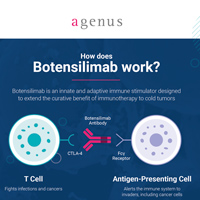
Botensilimab (Fc-enhanced anti-CTLA-4) plus Balstilimab (PD-1 inhibitor) is a next generation immunotherapy combination currently enrolling the phase 3 BATTMAN trial for microsatellite stable (MSS) metastatic colorectal cancer (mCRC).
Agenus Pipeline
Agenus clinical stage pipeline targets complementary mechanisms of the cancer immunity cycle.
± Botensilimab
Collaborations
Agenus accelerates the development of select programs through partnerships with industry leaders.